

I’d never heard of Fortaleza before I met Steffany.
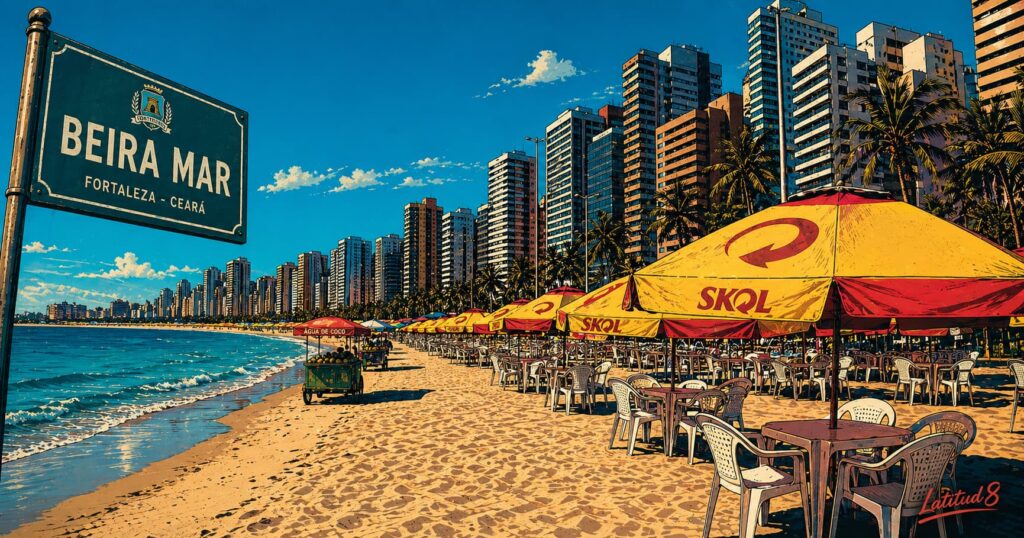
I’m Irish, from Dublin. My knowledge of Brazil at that point was the usual shortlist — Rio, São Paulo, maybe Salvador if I was feeling well-read. When Steffany, who was born and raised in Fortaleza, started showing me photos in a Dublin pub in December 2017, I didn’t have a reference point for any of it. She called it the Miami of Brazil. Looking at the coastline, the long stretch of beach, the city rising behind it, I could see why.
When I finally got there in February 2019, the photos turned out to be underselling it — not for the beaches, but for the people. I couldn’t speak a word of Portuguese. It didn’t matter. Everywhere I went there was a handshake, a welcome, and a cold Skol dropped into my hand before I’d had time to work out what was happening.
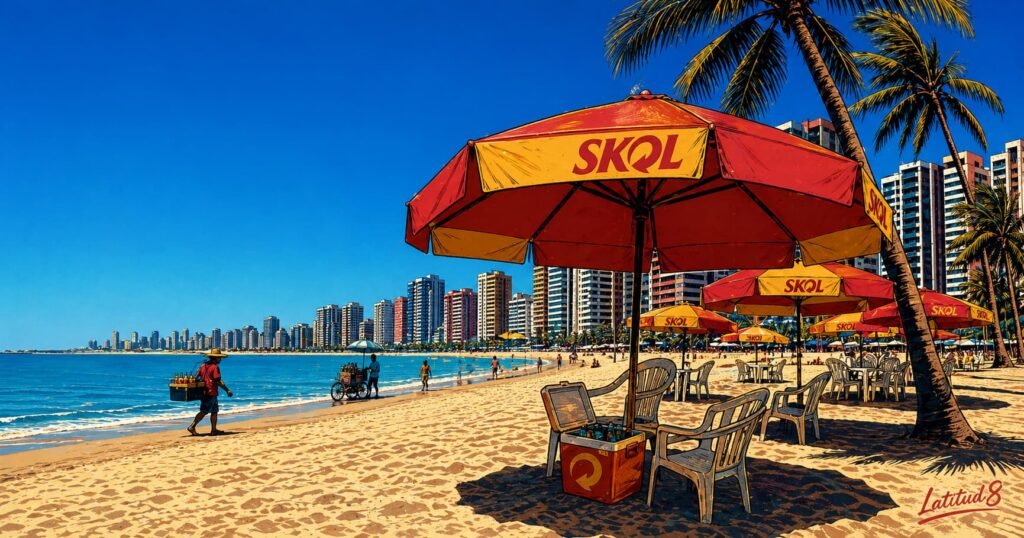
Growing up in Ireland, a beach trip meant packing your own sandwiches and hoping the rain held off. Here, you didn’t bring anything. You sat down, and the beach came to you — vendors with fresh crabs and cold beer, live music, plastic chairs right on the sand. I remember thinking: this is a completely different set of rules.
This article is the honest overview before you go further. Not a highlights reel. By the end you’ll know exactly what daily life in Fortaleza is actually like for digital nomads — the costs, the safety, the weather, the food, and whether it’s worth your time as a base.
What kind of city is Fortaleza, really?

Fortaleza is the fifth-largest city in Brazil, with around 2.7 million people. It sits on the northeast coast, close enough to the equator that the climate barely shifts across the year: hot, reliably sunny, with a strong Atlantic wind that takes the edge off the heat.
It doesn’t feel like a megacity in the way São Paulo does. Parts of it are genuinely unhurried, which surprises people who arrive expecting the density and intensity of the southeast. That said, it’s still a major Brazilian city. The traffic is real. The bureaucracy takes patience. The contrasts between neighbourhoods are sharp.
One thing worth knowing early if you follow football: Fortaleza has two clubs — Fortaleza EC and Ceará SC. They are fierce rivals. Steffany supports Fortaleza EC, as her family always has. I was informed of this within about twenty minutes of landing and have known better than to forget it since.

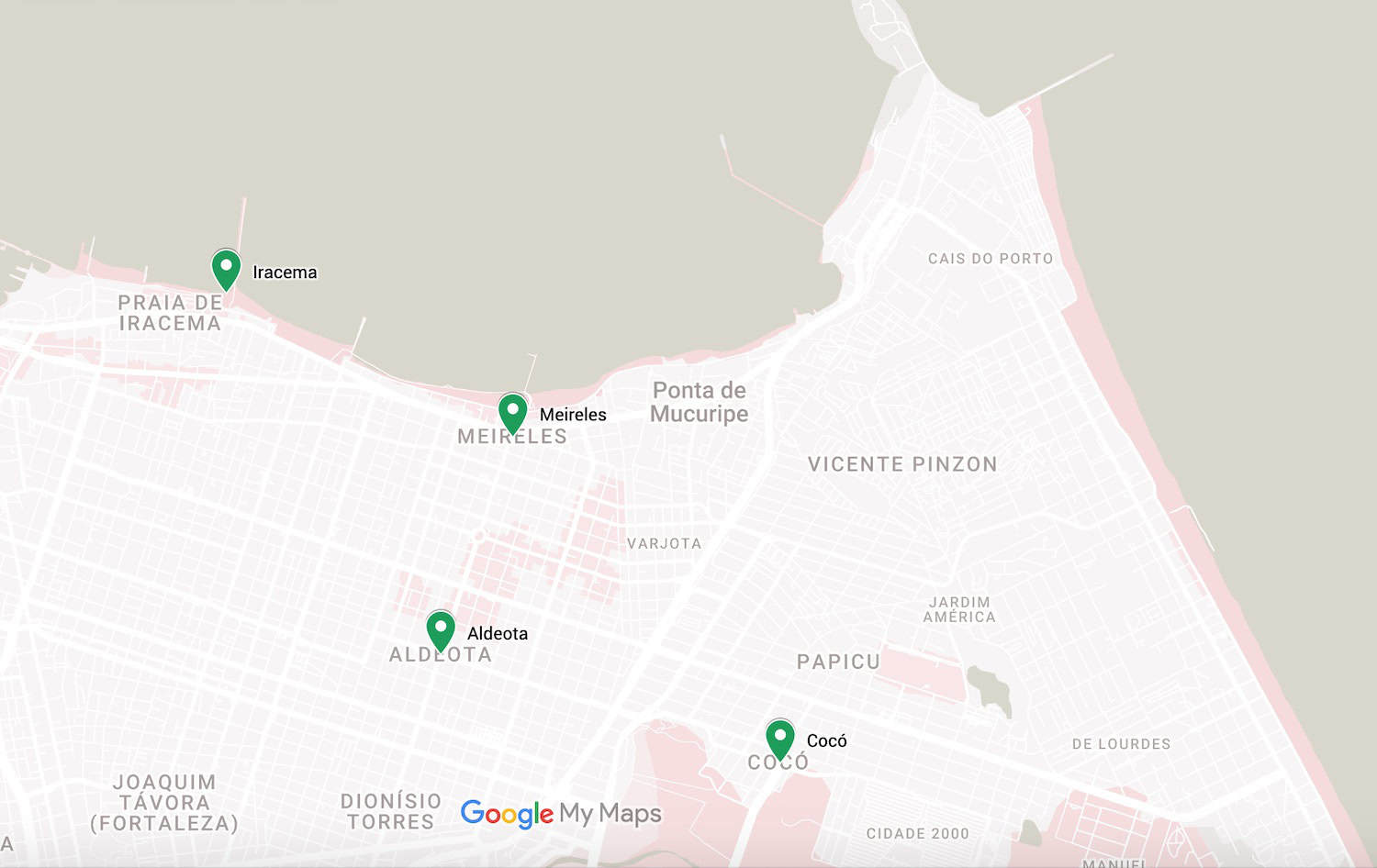
The areas where most digital nomads end up are Meireles, Aldeota, Iracema and increasingly Cocó — covered in full in our guide to the best neighbourhoods in Fortaleza for digital nomads. These are relatively safe, well-served by restaurants and cafés, close to the beach, and have solid enough infrastructure for remote work. The rest of the city is a different story. More on that below.
Getting to Fortaleza — flights and what to expect on arrival

Fortaleza is served by Pinto Martins International Airport (FOR), about 6 kilometres south of the city centre. For a city of this size it is well connected. TAP operates direct flights from Lisbon — roughly seven hours — which makes Fortaleza genuinely accessible from western Europe without routing through São Paulo. From North America there are connecting options through São Paulo or Bogotá.
The airport itself is worth mentioning, because it is unlike most airports I’ve walked through. Coming off the plane and heading toward baggage claim, the walls and floor are covered in illustrated artwork promoting Beach Park — the enormous water park on the coast outside the city. There are water-effect graphics on the floor that genuinely look like you’re walking into the sea. The rest of the murals rotate across the year and cover local culture and tourism, but Beach Park was my first experience of it. Airports are usually cold, anonymous, a bit authoritarian in feel. This one puts a smile on your face before you’ve even collected your bag. It felt like the city was already making its case.
Getting from the airport to the city

Uber is the straightforward option and works reliably at the airport. The process is: exit baggage claim, walk outside the terminal, open the app, and follow it to the rideshare pickup zone. You cannot be collected directly at the arrivals doors — drivers use a designated area — but the pickup is fast and the app navigates you there without any difficulty.
One thing to know in advance: taxi drivers inside and just outside the terminal will sometimes tell you Uber is not allowed at the airport, or that it’s illegal. It isn’t. Taxi drivers have official airport concessions and a strong incentive to steer you toward their fixed-price fares. The price difference is significant — a taxi to central Fortaleza typically runs R$70–120, while Uber to the same area is usually R$25–50. Occasionally a driver will message you to walk to the parking area or the departures level for an easier pickup. That’s not a problem — it just reduces the airport traffic they have to navigate.
Journey time to Meireles or Aldeota is around 20 minutes under normal conditions. Have your accommodation address saved in Portuguese and entered in the app before you get in the car.
Getting around Fortaleza day to day

Uber and 99 are how most digital nomads move around the city. Both work reliably across the main neighbourhoods. Costs are low — trips between Meireles and Aldeota run to a handful of reais. The bus network exists and covers the city, but it is complex and not set up for visitors who don’t know the routes yet. For day-to-day movement, the apps are the practical answer.
There is a dedicated cycling path running the length of Beira Mar, and in the early morning or late afternoon it is genuinely pleasant. Beyond the seafront, cycling in Fortaleza’s traffic requires real familiarity with the roads. Not recommended as a primary option, particularly early in a stay.
If you plan to explore the coastline outside the city — Jericoacoara, Cumbuco, Canoa Quebrada — car rental is worth considering. Having your own vehicle opens up the coastline considerably. Just apply the same logic covered in the safety section: amber flashing lights at night mean slow down, check, and keep moving.
How do you find accommodation in Fortaleza as a foreigner?

The practical approach most experienced nomads use: start with Airbnb or Booking.com for your first few weeks, get your bearings on the ground, then move to a direct rental once you know which neighbourhood actually suits you. Jumping straight into a long-term lease without having been there is a risk — and in Fortaleza, where the difference between neighbourhoods is sharp, it is worth taking the time to see what you’re renting before committing.
For longer stays, the two dedicated property platforms are Zap Imóveis and Viva Real — both well-stocked with Fortaleza listings and the first places most people land when searching. OLX is also worth checking: it is Brazil’s largest general trading platform, covering everything from cars to furniture to apartments, and private landlords list there directly alongside agencies. All three are in Portuguese, and landlords will expect at least basic communication in the language.
One thing Steffany points out: how landlords advertise depends heavily on the neighbourhood. In Meireles and along Beira Mar, listings go through the platforms and real estate agencies — it’s higher-demand and the process is more formalised. In other parts of the city, the old way still works: a handwritten sign outside the building and someone to call. Steffany found her own apartment that way — walking the street, seeing a sign, making a call. It is still common enough in residential neighbourhoods away from the beachfront that it is worth keeping your eyes open.
What the process looks like in practice: landlords will typically ask for a passport, proof of income, and either a Brazilian guarantor — called a fiador — or a deposit of one to three months’ rent. Finding a fiador as a foreigner is not realistic. The deposit route is standard and widely accepted — budget for it upfront. Some landlords will also ask for a CPF number — Brazil’s tax identification number. Not all require it, and those that do will often accept a passport and deposit instead. It is worth knowing it may come up. Getting a CPF as a foreigner is possible and is covered in a separate guide.
One cost that catches people out: the headline rent is rarely the full number. Condomínio fees — building maintenance charges — and IPTU, the local property tax, are typically added on top. Ask for the total monthly cost including both before you commit. The difference between the listed rent and the real monthly outgoing can be meaningful.
Furnished apartments in Meireles and Aldeota are the obvious starting point for a first stay. They carry a premium over unfurnished, but it is reasonable by European standards and keeps the setup cost down while you work out whether Fortaleza is the right long-term base.
Is the internet good enough for remote work in Fortaleza?

Yes — with conditions.
Fortaleza has fibre broadband across its main residential and commercial neighbourhoods. The main providers are Vivo, Claro, and OI. Speeds in a decent apartment in Meireles or Aldeota will comfortably handle video calls, file uploads, and the general demands of remote work. ANATEL, Brazil’s telecoms regulator, publishes connection speed data if you want to dig into specifics before committing to an area.
A smaller local provider worth knowing about is Texnet. Steffany worked for them before we left Brazil, and when we stay at her family home in Fortaleza, we’re connected through their network. The speeds are solid.
What matters more is that when our connection dropped one evening, a quick call had their team diagnose and fix the problem remotely the same night. That probably has something to do with Steffany knowing people there, but her experience working for them was that service quality was the whole competitive strategy. They were a start-up going up against the big national providers and they knew the only way to take customers was to actually look after them. Worth checking if you’re in their coverage area.
They were a start-up going up against the big national providers and they knew the only way to take customers was to actually look after them.
The practical condition to be aware of: infrastructure is good, but setup takes time. If you’re renting furnished accommodation, ask specifically whether broadband is already installed, which provider, and what the actual speed is. Not all landlords have this information at their fingertips.
Getting a SIM card in Fortaleza

Getting a SIM card in Fortaleza takes about twenty minutes if you know where to go. Claro and Vivo have the best coverage across the northeast. Both have stores in Shopping Iguatemi and other malls in Aldeota — the mall environment is easier to navigate than street-level shops for this kind of admin, particularly if your Portuguese is still developing.
You’ll need your passport. A CPF number helps — some stores will process a sale without one, others won’t. If you don’t have a CPF yet and hit a wall, picking up an eSIM before you arrive is a clean workaround. You set it up before you land, it covers Brazil, and you’re connected from the moment you walk off the plane.
Prepaid plans are cheap and flexible. A solid monthly data package from Claro or Vivo covers everything a remote worker needs — calls, navigation, and backup connectivity for the moments when your home broadband plays up. Top up online or at any convenience store that carries their payment options.
Where can you work in Fortaleza? Coworking options and cafés
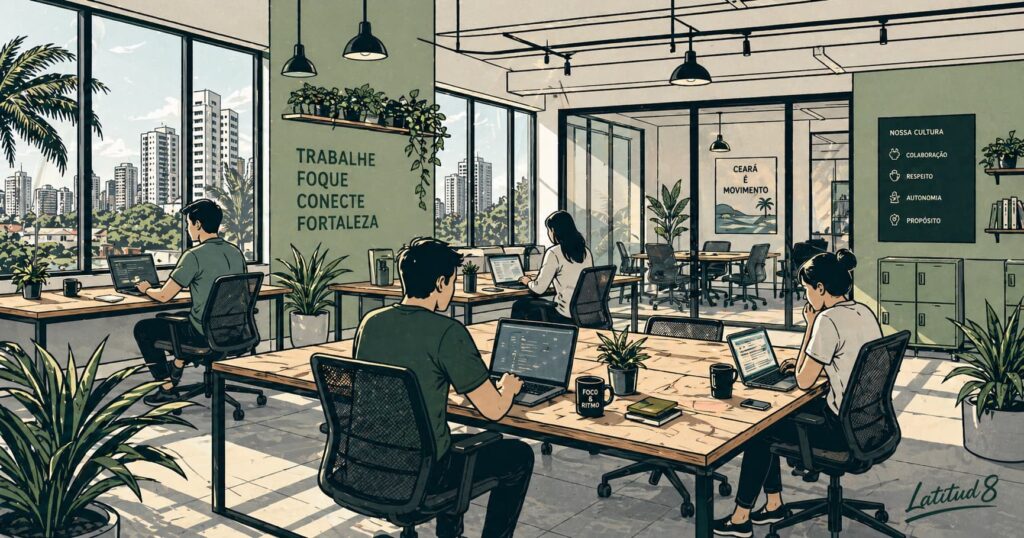
The coworking scene in Fortaleza is functional rather than extensive. There are solid options, they are not expensive, and a couple of them have built real communities. For a city of this size the infrastructure is more developed than people expect — which probably says something about how many Brazilians are now working remotely.
The names that come up most consistently are Elephant Coworking in Aldeota, DOM Coworking for private office space, and Go! Office Coworking for a more modern environment with good access to restaurants and cafés nearby. Repart Coworking gets strong reviews for its atmosphere and Coworking long-term.
Do you actually need a coworking space?

Honestly — probably not to start with. Every time I’ve needed to work in Fortaleza I’ve done it from wherever we were staying. A good apartment with solid broadband handles most of what remote work actually requires. Every trip we’ve made has been to see Steffany’s family, not to set up as a remote worker — so my working-from-Fortaleza experience is a kitchen table at her parents’ house and whatever the Airbnb broadband could manage. Both were fine.
Where coworking makes sense is if your accommodation broadband turns out to be unreliable, if you’re staying somewhere without a proper desk setup, or if you’re there long enough that you want a change of scene and some human contact during the working day. For a first trip of a few weeks, the apartment is fine. For a longer stay, having a coworking option you’ve checked out is worth knowing about.
What does it cost to live in Fortaleza?
Less than you probably think — and less than almost anywhere in western Europe or North America. More than some Southeast Asian alternatives. That’s the honest summary.
Realistic monthly figures for a digital nomad living well in Meireles, Aldeota, Iracema or Cocó — the full breakdown is in our cost of living in Fortaleza guide, but here’s the interactive summary:
Exchange rates used: €1 = R$6.00 · US$1 = R$5.40. Rates shift — verify current rates before budgeting.
Rents in Fortaleza have been rising quickly — treat these as a starting point and verify current rates before committing. Exchange rates shift too, so check current rates before budgeting.
On the ground, it’s very easy to spend well. One of the things I love about Fortaleza is The Coffee, a chain of small grab-and-go specialty coffee booths that have spread all over the city.

They’re not much to look at, but the coffee is genuinely good and a fraction of what you’d pay at the cafés down on Beira Mar. The beachfront is beautiful and worth your time, but if you’re watching a budget, you’ll quickly learn that the tourist strip adds a tax to everything. A few streets back, the prices are different.
A rodrizio pizza dinner — bottomless pizza, bottomless beer, until you physically cannot continue — is one of the better value meals I’ve had anywhere. It’s that kind of city.
Numbeo has cost of living data for Fortaleza that’s broadly accurate as a starting point. The rent figures tend to lag behind the current market, so treat them as a floor rather than a reliable prediction.
If you want to run your own numbers properly, I built a dedicated Fortaleza Monthly Budget Calculator — neighbourhood, lifestyle, and income all factored in.
One cost that catches people out is currency conversion. If you’re earning in euros or dollars and spending in reais, the rate you get matters. Going through a Brazilian bank is expensive — the spread is wide and the fees are real. We use Wise for converting and sending money, and the difference compared to a standard bank transfer is significant enough that it’s worth factoring into your budget from day one. On a monthly budget of €1,000 / US$1,100 you’re talking about a meaningful amount lost or saved depending on how you move it.
money via a bank
no fixed address needed
Is Fortaleza safe for digital nomads?

This is the question everyone asks and nobody wants to answer directly. So here’s the direct answer.
Fortaleza has a serious crime problem. It consistently appears in global statistics on violent crime, particularly in peripheral neighbourhoods. This is real, and anyone doing proper research will find those numbers. Glossing over them would be dishonest and, frankly, would lose your trust immediately.
What’s the realistic risk for a digital nomad?

Every city in the world has parts that are unsafe. Fortaleza is no different — it just gets talked about as though it’s exceptional, which isn’t the full picture.
The practical reality is straightforward: don’t wave your phone around, don’t wander into areas you don’t know, don’t walk anywhere late at night. Basic awareness that you’d apply in any major city, applied here with a bit more consistency.
For a full breakdown of how safety in Fortaleza actually works — neighbourhood by neighbourhood, with context the statistics don’t give you — see our guide to is Fortaleza safe.
I never experienced a single incident. I never felt uneasy. But I also wasn’t wandering aimlessly. That’s the difference. The people who have problems are usually the ones who stopped paying attention. Knowledge is the key. Know where you are, know where you shouldn’t be, and Fortaleza is a lot more manageable than the statistics suggest.
Before my first visit, Steffany gave me the full briefing. Motorbikes pulling up at traffic lights. Windows getting smashed. The logic of keeping your phone in your pocket whenever you’re in a car. I arrived half-expecting to feel the tension constantly. I didn’t. I was careful, as anyone should be, but I never once felt unsafe in the areas where I was spending time.
One afternoon on Beira Mar I watched a family have their iPads and iPhones lifted from their beach chairs while they were in the water. Classic mistake: valuables left visible and unattended. They found the police huts along the beach (there are several, which is worth knowing), reported it, went back to their hotel, and used Find My iPhone to locate everything about three hundred metres down the strand. They got it all back.
Apparently thieves in Fortaleza are generally wise enough to avoid Apple products. Too easy to track. This one, clearly, hadn’t got the memo.

Worth knowing: at night, traffic lights switch to flashing amber. You don’t stop — you slow down, check that it’s clear, and keep going. The first time I drove through one of those intersections at night I thought something had gone very wrong. It’s a safety measure, and once you understand why it exists it makes complete sense.
Know where you are, and ask before you wander. I got lucky. You might not.
Then there’s the run. I went for an early morning run along Beira Mar, supposed to do five kilometres, felt good, kept going. When I showed Steffany the route on Google Maps afterwards she nearly put her phone through the table. I had run, entirely without realising it, through an area that even locals don’t go on foot. I maintain it was a perfectly pleasant run and I felt fine throughout. Steffany spent the next two weeks telling everyone she knew. I still stand by the run. The point is: know where you are, and ask before you wander. I got lucky. You might not.

One thing that belongs in the safety conversation and often gets left out: health cover. Brazil’s public healthcare system, SUS, is technically open to everyone, but in practice the experience for foreigners is inconsistent. If you get sick or injured in Fortaleza without cover, you’re paying out of pocket in a country where a hospital visit can run to thousands of reais.
We use SafetyWing which is built for remote workers and covers you across borders without requiring a fixed address. It’s not expensive. Not having it is a false economy.

money via a bank
no fixed address needed
What’s the weather actually like in Fortaleza?
Consistently warm — which is either the whole point or a mild concern, depending on where you’ve come from.
Fortaleza has two main seasons: dry (roughly June to January) and rainy (roughly February to May).
Does it rain in Fortaleza?

Yes — but not in the way the word 'rainy season' usually implies.
I visited at the end of February once, right in the middle of it. It rained. Sometimes heavily. But it rained the way rain is supposed to work — storms that had a beginning, a middle, and an end. The air cleared. The heat came back. Nothing like the grey drizzle that settles over Ireland for about six months of the year and just refuses to leave.
We never let the rain stop us going to the beach. We just checked the forecast and went in whichever window looked better — morning or evening, depending on what was building. It was still hot throughout. The storms were, honestly, a bit of a relief.
Average temperatures run between 26–32°C year-round. The Atlantic wind keeps things from becoming genuinely unbearable, even at peak heat.
One thing that caught me off-guard initially: it gets dark around 5pm. Coming from Europe, where in summer the sun is still up at 9 or 10pm, that early darkness felt strange at first. Now I like it. It's an unmistakable signal that the heat of the day is done and the evening is starting. There's something clarifying about it.
Do you need to speak Portuguese in Fortaleza?

Yes — more than you might hope. But the people make it far less painful than the language gap suggests.
English is not widely spoken outside tourist-facing places. In local restaurants, at supermarkets, with landlords, with any kind of official — you'll need Portuguese. If you can't manage it, prepare to do a lot of menu pointing.
I arrived knowing none of the useful words. Steffany had taught me a selection of colourful ones, which I had the sense to keep to myself. I got by, but I was dependent in ways that got old quickly.
The people who were clearly having the better experience were the ones who'd put in even a modest amount of effort with the language. You don't need fluency. You need enough to greet people properly, order food and drinks without resorting to mime, and navigate a supermarket without holding up the queue.
Near Beira Mar you'll get reasonably far with slow English in restaurants and beach bars. Five minutes off the tourist strip, that stops being true.
What I can't overstate is how much the locals will meet you halfway. Make any attempt at all — even a mangled 'boa tarde' — and people respond warmly, fill in the gaps, and get you where you need to go.
Steffany says the northeast accent sounds like singing to other Brazilians. Once your ear adjusts it really does have a particular warmth to it. It's also notably different from São Paulo or Rio Portuguese, so if you've been studying from resources based in the south, expect a brief recalibration when you arrive.

What's the food like in Fortaleza?

Better than I was prepared for, and different from what most people picture when they think of Brazilian food.
Northeast food culture is its own thing entirely. Feijão, tapioca with eggs and cheese for breakfast, carne de sol, baião de dois: dishes that belong to this part of Brazil and are done properly here. The meat at a churrascaria is the kind of thing you find yourself thinking about on the flight home. The sausages alone — spicy, cheesy, a bit ridiculous — are worth the trip.
On the beach, Steffany heads straight for the oysters and fresh crabs, brought around by vendors working the waterline. I go straight for the pizza. We've had this same disagreement every visit and I expect we always will.

Rodizios, Two Brothers, and the pizza situation
Fortaleza's rodizios deserve a proper mention. You sit down, pizza arrives continuously, beer is bottomless, and this continues until you wave the white flag.

The toppings are not what you expect — there's a cream cheese variety that sounds wrong until it isn't, and a sweet pizza with condensed milk and melted chocolate that I was completely sceptical about until I ate three slices. One thing that threw me the first time: almost nobody eats the crust. They eat the slice and leave the edges on the plate. Completely standard. Don't ask questions. Just do the same.
Spiderman handed me a slice of chocolate pizza at eleven o'clock on a Saturday. I have no complaints.
Two Brothers is worth a mention specifically. It's outside, the only beer on offer is Budweiser — bottomless — there's a DJ, loud music, and on the right night people dressed as superheroes working the floor. Spiderman handed me a slice of chocolate pizza at eleven o'clock on a Saturday. I have no complaints.

Steffany has a theory I've come to agree with: Brazilians take an international cuisine, make it their own, and almost always improve it. The cooked sushi here is a good example. It sounds like it shouldn't work. It does.
The day-to-day rhythm in Meireles or Aldeota falls into place fairly quickly. Supermarkets are well-stocked. iFood and Rappi work well for delivery and cost almost nothing by European standards. The practical stuff — groceries, coffee, getting work done — stops being an effort after the first week or two.
What takes real adjustment is pace. Things happen when they happen. Appointments are approximate. Brazilians are not running on the same clock as northern Europeans, and fighting that is a losing battle. Let go of it and the city opens up considerably.
Is Fortaleza the right base for you?
For a deeper version of this same question — six questions instead of four, plus a shareable result — take the full quiz on whether Fortaleza is right for you.
Not everyone who goes to Fortaleza loves it. Some people arrive expecting a version of Southeast Asia — low costs, English widely spoken, a ready-made nomad scene — and find something quite different. Others arrive with no strong expectations and wonder why it took them so long to get there.
The honest answer is that Fortaleza rewards a certain kind of flexibility. Things run on Brazilian time. The bureaucracy moves slowly. If you can genuinely make peace with that — not just tolerate it — the city gives back considerably more than it asks for.
The people who love Fortaleza tend to have one thing in common: they are not trying to recreate the life they had somewhere else. They came because it is different, and they made peace with the differences. The people who struggle are usually the ones fighting the city rather than working with it.
Is there a digital nomad community in Fortaleza?

Honest answer: not in the way there is in Medellín, Lisbon, or Chiang Mai. There is no pre-built infrastructure of nomad meetups, coliving spaces, and Slack channels waiting for you to arrive. What there is instead is a growing population of Brazilian remote workers in the main neighbourhoods, a handful of coworking spaces where those communities form, and an international scene that is present but small.
That is not necessarily a disadvantage. Fortaleza is not a nomad city — it is a real city where nomads can live well. The distinction matters. If you want to walk into a hostel common room and immediately find six people who also work online and want to grab a beer, Fortaleza is probably not that. If you want to build your own rhythm in a place with genuine culture, excellent food, and no tourist infrastructure built around you, it is considerably better.
The community that exists is worth finding. Facebook groups for expats in Fortaleza and Ceará are the most active informal channels — search in Portuguese (Expats Fortaleza, Nômades Digitais Fortaleza) and you'll find them. Coworking spaces like Elephant and Repart are where the Brazilian remote worker community actually gathers. Showing up regularly is how you meet people. It takes longer than in cities with established nomad scenes. The connections tend to be deeper for it.
The real social life in Fortaleza doesn't happen in bars aimed at visitors. It happens at the beach on a Saturday — groups of friends under trees and umbrellas, cold beers, music, the afternoon stretching out with no particular agenda. Steffany grew up doing exactly this, and I got pulled into it on several trips. Her friends didn't need a reason to include a confused Irishman who couldn't follow the conversation. They just did.

Before a beach day, or before a night out, Steffany and her friends would often meet at a gasolina first. Not a bar — a petrol station. In Fortaleza, certain petrol stations have become de facto social spots: locals pull up, grab cold beers, stand around talking, and work out where the night is going. It is so local that most visitors never encounter it. I find it quietly brilliant. If you get invited to one, go.

Day trips and weekend escapes from Fortaleza
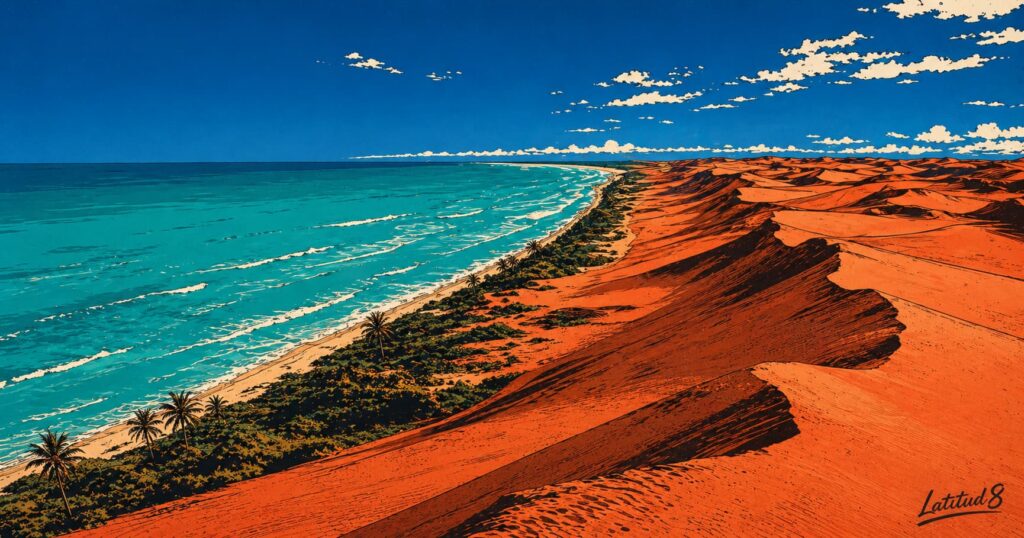
One of the underrated parts of basing yourself in Fortaleza is what's within reach. The coastline of Ceará is genuinely one of the best in Brazil, and most of it is an easy drive from the city.
Cumbuco — 30 minutes west

Cumbuco is the quick escape. Around 30 kilometres from Fortaleza, it's a small beach town built around dunes, lagoons, and one of the best kitesurfing spots in Brazil. The wind here is consistent and strong from June to January, which lines up almost exactly with the dry season — you'll see kite schools and kiters working the water on any given afternoon during those months. Windsurfing is big here too.
If you're not a kiter, there's still plenty of reason to go. We visited once and spent the day at a beach club — swimming, cold beers, fresh crabs, and absolutely no agenda. The dunes are worth exploring and buggy tours run along the coast. It's a relaxed half-day or full day depending on how long you want to stay.
Canoa Quebrada — around 2.5 hours southeast

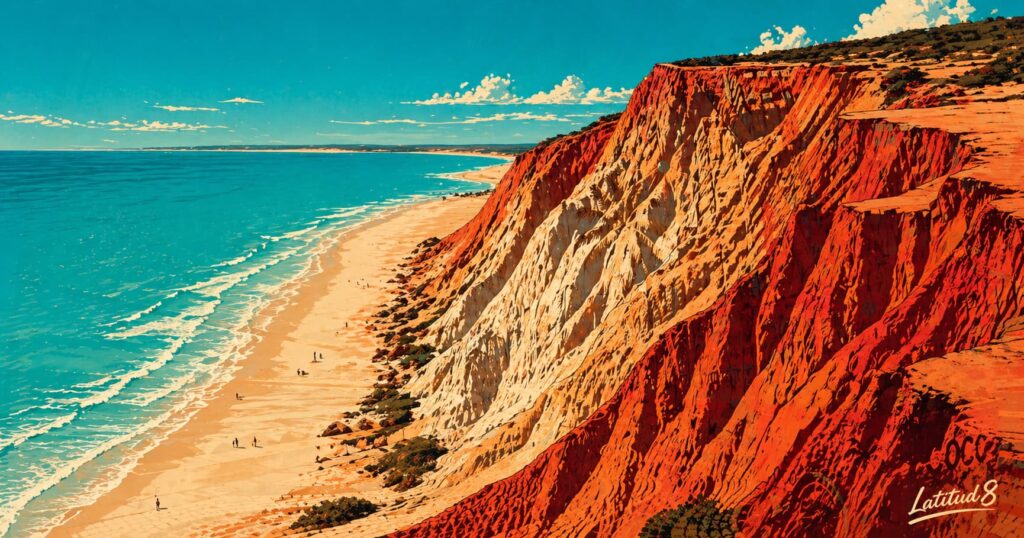
Canoa Quebrada is about 165 kilometres from Fortaleza along the Sol Nascente highway — roughly two and a half hours by car. We did it as a day trip with Steffany's family. It's doable, but you can't do everything in a day. Next time, we'd stay at least one night.
The jeep tour through the dunes was the highlight. It's the kind of thing that sounds like a tourist trap until you're actually out there, bouncing across red sand with the cliffs dropping to the ocean below you. Steffany's mum cried. I'm not going to pretend I wasn't close.
After the dunes we went to the beach for food and a swim. The waves were enormous — the kind that have real power behind them. Steffany's mum watched me, the gringo, jump through them with what I can only describe as deep concern. I thought it was great. We have different definitions of great.
We also did paragliding — our first time. Launched from the clifftops, which are spectacular from the air. I'm not scared of heights, just of what happens if something goes wrong at height. The instructor had a different philosophy about cliff proximity than I did. It was brilliant. I don't think I'll do it again.
Worth knowing before you book a kite lesson or a paragliding trip: standard nomad health cover often excludes adventure activities entirely. We use World Nomads for anything in that category — it's built around exactly this, not a general policy with an activities exclusion buried in the small print.
duration and activities
We receive a fee when you get a quote from World Nomads using this link. We do not represent World Nomads. This is not a recommendation to buy travel insurance.
There's a nightlife strip — Rua Dragão do Mar, known locally as Broadway — lined with bars and restaurants. We didn't get to it on our trip. It's the reason to stay overnight.
Jericoacoara — 4–5 hours northwest

Jericoacoara is not a day trip. It's around 300 kilometres from Fortaleza and the last stretch, roughly 45 minutes, can only be made in off-road vehicles across sand. Most people go for at least two nights. What you get is a beach town with no paved roads, massive dunes, freshwater lagoons, and a sunset ritual on the dune above the village that people fly to Brazil specifically to see. The inconvenience of getting there is part of what keeps it from being overrun. Worth the effort.
How does Fortaleza compare to other digital nomad cities in Brazil?
I've only ever based myself in Fortaleza. Take this comparison for what it is. What I can tell you is what keeps us going back: the cost is real, the sun is real, the beaches are better than anywhere else I've been in Brazil, and the people have a warmth that's hard to explain until you've experienced it.
Vs. São Paulo: More infrastructure, more expat community, better English. Also more expensive, worse weather, no coast. If your work requires proximity to Brazilian business or a major international hub, São Paulo makes practical sense. Otherwise the tradeoffs favour Fortaleza for an actual nomad lifestyle.
Vs. Rio de Janeiro: Rio has the brand and the energy. It also has higher costs and, in comparable areas, higher security considerations than people expect. And — I'll say this knowing it's a controversial position — the beaches in Fortaleza are better than Copacabana. Rio is just more famous. That's not the same thing.
Vs. Florianópolis: Popular with Brazilian and Argentinian nomads, strong beach culture, an established expat scene. More expensive than Fortaleza and with cooler, more variable weather. A solid option if you want a ready-made nomad community around you.
Fortaleza's case is simple: low costs, reliable sun, genuine local culture, improving infrastructure, none of the tourist machinery of Rio or Florianópolis, and about seven hours from mainland Europe. For anyone living between two continents, that last point matters more than it might seem.
The other reason — the less strategic one — is that it's Steffany's home. Her family is here. The people are some of the warmest I've encountered anywhere, and Brazilians already set a high bar for that. Every time we leave, leaving is harder than the time before. That's probably the most honest thing I can say about the place.
Is Fortaleza worth it for digital nomads?
Yes — for the right kind of person.
If you want reliable sun, low costs, excellent food, and a city that has genuine character rather than a nomad infrastructure built around you, Fortaleza delivers all of it. The beaches are real. The warmth of the people is real. The cost of living is real.
If you need a large English-speaking community, everything to run on schedule, or polished expat infrastructure from day one — you'll have a harder time. Fortaleza doesn't bend itself to visitors. It runs on its own terms. That's part of what makes it worth going to. If you want the unfiltered verdict — including what the negative reviews get right — read our full breakdown of whether Fortaleza is actually a good place to live.

Fortaleza for Digital Nomads: FAQs
Is Fortaleza good for digital nomads?
It depends on what you're after. If you want low costs, reliable sun, and genuine local culture without needing an English-speaking expat scene around you, it's a strong option. The remote work infrastructure is solid in the main nomad neighbourhoods. The tradeoffs are real — Portuguese is non-negotiable, safety requires awareness, and Brazilian bureaucracy moves slowly. But for the right kind of remote worker, it makes a lot of sense.
What is the cost of living in Fortaleza for a digital nomad?
A comfortable life in Meireles or Aldeota — furnished apartment, eating out regularly, Uber for transport — comes to around R$5,000–9,000/month. The full breakdown by category is in our cost of living in Fortaleza guide. At current exchange rates that's roughly €850–1,500 / US$930–1,650. The lower end is realistic if you cook more and choose accommodation carefully. The upper end gets you a nicer apartment and few compromises.
Is Fortaleza safe for foreigners?
Safer than the crime statistics suggest for people living in the main residential areas, and riskier than most western cities. The realistic risk for a digital nomad in Meireles or Aldeota is opportunistic petty crime — phone snatches, valuables left unattended on the beach. Standard urban awareness applies and matters here more than in most European cities. The people who have problems are usually the ones who stopped paying attention.
Do I need to speak Portuguese to live in Fortaleza?
In practice, yes. English is limited outside tourist-facing businesses near Beira Mar. Daily life — landlords, local restaurants, supermarkets, any kind of bureaucracy — works much better with at least conversational Portuguese. You don't need fluency. You need enough to greet people properly, order food without resorting to mime, and navigate a supermarket without holding up the queue. The locals will meet you halfway every time — but you do need to make the first move.
What is the best neighbourhood in Fortaleza for digital nomads?
Meireles is the most practical starting point — walkable, close to the beach, well-served by restaurants and cafés, and with enough infrastructure that the first few weeks don't require much figuring out. Aldeota is quieter and slightly cheaper for similar amenities. Cocó is gaining ground as a more residential option for longer stays. Most people start in Meireles and work out from there once they know the city better.
Can I stay in Fortaleza long-term on a digital nomad visa?
Yes. Brazil introduced its digital nomad visa (officially VITEM XIV) in 2022. It allows remote workers employed by companies outside Brazil to live in the country for up to one year, renewable for a second year. The minimum income requirement is US$1,500 per month, or a bank balance of US$18,000. You'll need proof of remote employment, health insurance valid in Brazil, and a clean criminal record. Applications go through your nearest Brazilian consulate. One thing worth knowing: if you spend more than 183 days in Brazil in a 12-month period, you become a tax resident — worth discussing with a tax advisor before committing to a long stay.
What is the best time of year to visit Fortaleza?
June to January is the dry season and the clearest window for a first visit. The sun is reliable, the wind off the Atlantic keeps the heat manageable, and the beach conditions are at their best. February to May is the rainy season — but it rains the way rain is supposed to work, with storms that have a beginning, a middle, and an end. It doesn't close the city down. Temperatures run between 26–32°C year-round regardless of season, so there's no bad time in that sense — just a better one.
