Health insurance is the part of the Brazil move that trips people up more than housing or visas combined — not because it’s complicated, but because every article online is either a generic “digital nomad insurance” roundup that’s never set foot in Fortaleza, or a visa lawyer’s page that only cares about satisfying a consulate checklist.
Neither answers the actual question: what do you buy, and when do you switch from one type to another?
The honest answer isn’t one product. It’s matching the right category of insurance to how long you’re actually staying, and knowing when a local Brazilian plan beats an international one outright.
This is that breakdown — what the visa actually requires, what short stays and long stays need differently, what it really costs to get sick here without cover, and what a claim actually looks like when you need one.
Do You Actually Need Health Insurance in Fortaleza?

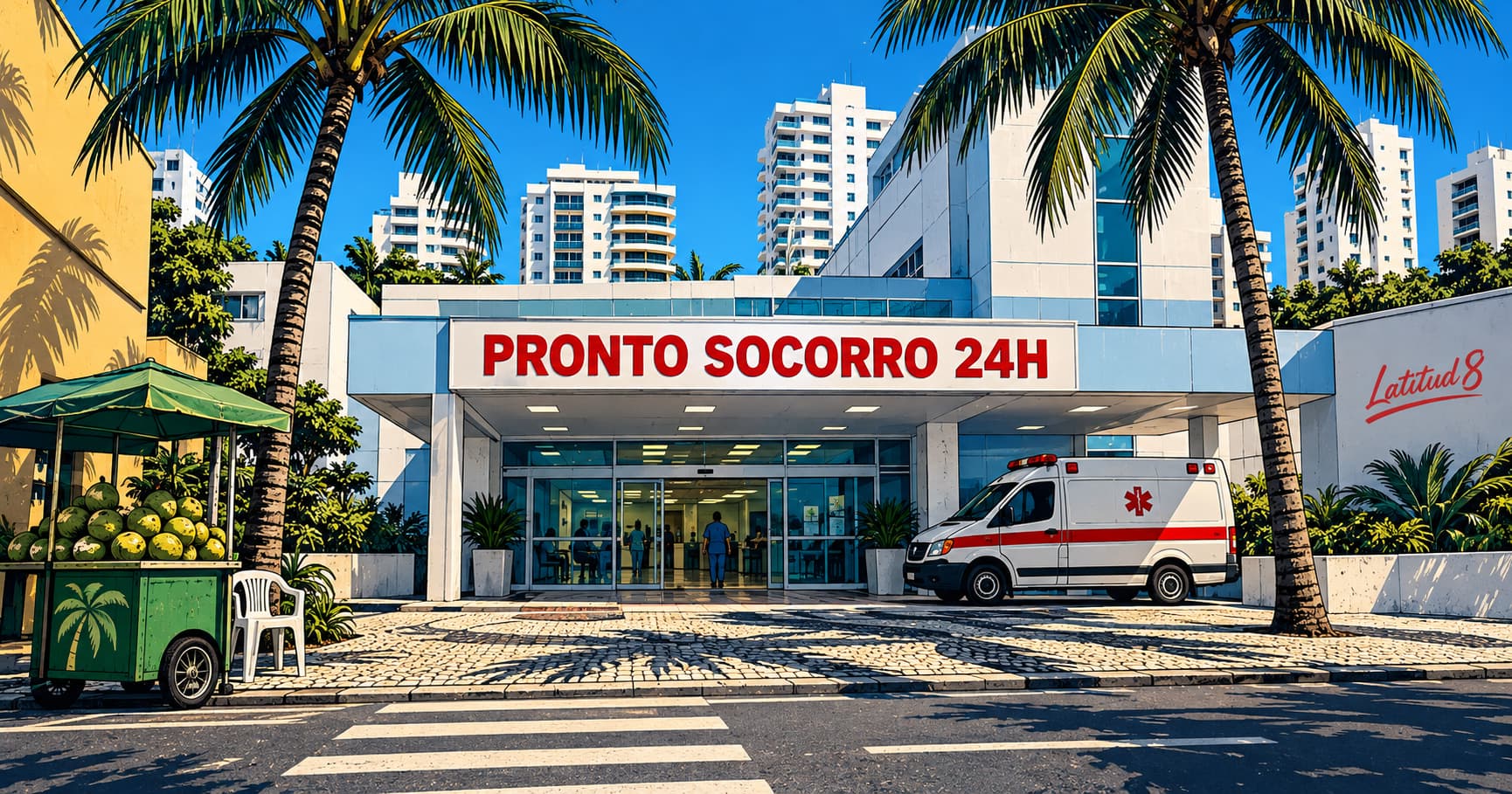
Brazil has SUS (Sistema Único de Saúde), a public healthcare system that’s constitutionally universal and free at the point of use. That includes foreigners, with no residency requirement to be treated in a genuine emergency. Available is the right word, though, not reliable.
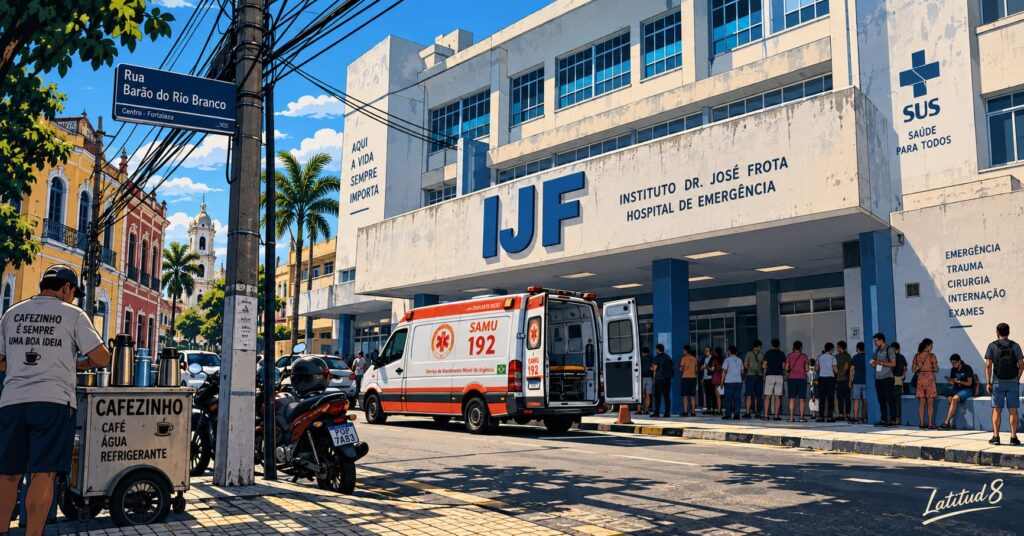
Wait times for non-urgent care can be long, and quality varies enormously by hospital and neighbourhood. In Fortaleza, Instituto Dr. José Frota (IJF) in Centro is the main public trauma and emergency referral hospital. It’s free, but busy, and Portuguese-only in practice.
For the wider public-versus-private trade-off, see is Fortaleza a good place to live.
Private healthcare in Brazil is good, and it’s inexpensive by US or northern European standards. But “inexpensive” still means real money without insurance, and it means paying upfront, in Portuguese, while you’re unwell. Most nomads live in Meireles, Aldeota or Cocó (is Fortaleza safe covers the neighbourhood-by-neighbourhood picture in more depth). In that area, Hospital Monte Klinikum in Meireles is the private ER most people end up at. It’s a full 24-hour emergency department, but a paid facility, so bring insurance details or a card.
The reality is most people treat this as either/or. It isn’t. SUS is worth understanding well enough to use in a genuine emergency: you don’t want to be figuring out where the nearest public hospital is for the first time while you’re sick. Private insurance is what you plan around for everything else.
Is Your Existing Home Insurance Enough?

Before comparing new providers, it’s worth asking whether you actually need one at all. If you have EU health cover through an EHIC-style reciprocal arrangement, that generally doesn’t extend to Brazil — those agreements are intra-EU or bilateral with specific countries, and Brazil isn’t one of them for most European nationals. A US employer health plan almost never covers treatment outside the US at all, or does so only as a narrow, expensive out-of-network exception. A UK NHS entitlement stops the moment you’re not physically in the UK, with no Brazil reciprocal agreement to fall back on.
The practical answer for nearly everyone reading this: whatever you have at home stops being useful the day you land in Fortaleza, unless it’s specifically sold as international or expat cover. If you’re not sure, the one question to ask your existing provider directly is whether Brazil is a named covered territory and whether outpatient care (not just emergencies) is included — most home policies fail on the second part even when they technically pass the first.
What the Digital Nomad Visa Actually Requires

needed
to apply
If you’re applying for Brazil’s digital nomad visa (VITEM XIV) through a consulate outside Brazil, you’ll likely be asked for proof of health insurance. The figure consulates commonly request is around US$30,000 in medical emergency coverage, or the equivalent in euros.
Here’s what most guides don’t say clearly: that $30,000 figure isn’t a fixed legal minimum. The regulation behind the visa, Normative Resolution CNIg 45/2021, doesn’t set a specific dollar threshold. It’s what individual consulates have settled on asking for, and it can vary by post (source).
The bigger thing worth knowing: if you apply for residency from inside Brazil rather than through a consulate abroad, health insurance typically isn’t required as part of that application at all. That changes the calculation for anyone planning to arrive first and sort out longer-term status once they’re here.
Whichever route you take, the policy needs to show coverage valid in Brazil specifically, not just your home country, and it needs to run for the length of your intended stay. A straightforward “travel insurance” policy is sometimes rejected by consulates even when it has solid medical coverage, simply because of how it’s labelled.
Consulates don’t always check this as closely as the paperwork suggests they will. That’s not an invitation to skip it. A rejected application over a missing document costs far more time than sorting insurance properly in the first place.
Travel Insurance, Nomad Health Insurance, or a Local Plan: What’s Actually Different

These get talked about like they’re interchangeable. They’re not, and mixing them up is the single most common mistake I see people make with this decision.
Travel insurance (SafetyWing, World Nomads) is built for people on the move. It’s flexible, cheap by comparison, and easy to buy and cancel. It’s a poor fit once you’re settled somewhere for a year or more, partly on cost and partly because most of these plans exclude pre-existing conditions and reassess you as your situation changes.
Nomad health insurance (Genki being the clearest example) sits in between. It’s designed specifically for people who don’t have one fixed home country but do want continuous, real health cover rather than travel-style protection.
Local Brazilian plans (Hapvida, Unimed, Amil, Bradesco Saúde, and others) are what most actual residents use. They’re usually cheaper than international options and offer direct billing at partner hospitals with no reimbursement wait, which is a genuine advantage. The catch: they typically require a CPF number and Brazilian residency to purchase, which rules them out for anyone trying to sort insurance before they land.
There’s no single “best” here, whatever the roundup articles claim. The honest answer is whichever one you’d still hold in six months without having outgrown it or gotten priced out of it.
Best Health Insurance for Short Stays in Fortaleza

- R$1.29M overall medical coverage cap
- Excludes pre-existing conditions, maternity and cancer treatment
- Rolling plan billed every 4 weeks, or a 364-day plan paid upfront
- R$5.93M coverage cap, R$297 deductible per case (not applied to inpatient stays)
- Excludes mental health, maternity, preventive care and dental beyond accident-related treatment
- 14-day waiting period, waived if you were already covered or in your home country the day before your start date
- 1-year maximum per contract. Each new contract re-checks pre-existing conditions against the previous 12 months
Comparing more Genki plans? See every Genki option
If you’re in Fortaleza for a few weeks to a few months and not planning to stay, this is where SafetyWing, World Nomads, and Genki Traveler compete.
SafetyWing’s Essential plan is the real budget option here: R$529 per 4 weeks (roughly €89 / US$102.76) for a 43-year-old on the rolling plan, or R$476 per 4 weeks (roughly €80 / US$92.48) paid upfront on the 364-day plan, with an overall medical coverage cap of R$1.29M (roughly €217,000 / US$250,000). It explicitly excludes pre-existing conditions, maternity, and cancer treatment.
Worth knowing before assuming this is your price: SafetyWing’s marketing headline of R$323 (US$62.72) per 4 weeks is the 18-39 age band specifically. Price climbs from there: roughly R$476–529 for ages 40-49, R$747 for 50-59, and R$1,015–1,133 for 60-69 per 4 weeks on Essential. A nomad in their 20s pays notably less than the figures in this article; someone in their 50s or 60s pays considerably more. Their Complete plan, at R$1,306/month (roughly €220 / US$253.50) for the same 43-year-old, is again well above the R$914 (US$177.50) 18-39 headline rate. It adds preventative care and a higher level of cover (safetywing.com).
World Nomads is the weaker fit of the three for anyone reading this specifically. It’s built for shorter, more adventure-oriented trips, and per its own policy structure isn’t really designed around long stays. It’s worth knowing about if you’re doing something like surfing or diving on the side, but I wouldn’t lead with it for someone settling into Fortaleza life.

Genki Traveler is worth naming here too, separately from Genki Native later in this article. They’re different products for different situations. Traveler runs R$473/month (roughly €79.80 / US$92) for a 43-year-old, with a R$5.93M coverage cap (roughly €1,000,000 / US$1.15M) and a R$297 deductible per case (roughly €50 / US$58) that doesn’t apply to inpatient stays. It excludes mental health, maternity, preventive care, and dental beyond accident-related treatment, and carries a 14-day waiting period unless you were already covered or in your home country the day before your start date.
The real thing to know if you’re considering it: it has a hard 1-year maximum per contract. Each new contract re-checks pre-existing conditions against the 12 months before it starts. That’s fine for someone genuinely passing through, but not something to lean on if there’s any chance you’ll still be here in year two.
Best Health Insurance for Basing Long-Term in Fortaleza

Not sure Native is the right plan? Compare every Genki option
Once you know you’re staying, the calculation changes.
Genki Native is the clearest nomad-specific option built for this. Its Basic tier runs R$1,530/month (roughly €258 / US$297) for a 43-year-old with no deductible, with a R$5.93M coverage cap (roughly €1,000,000 / US$1.15M). Adding Premium benefits costs R$801/month more, which makes R$2,330/month in total (roughly €393 / US$453). It also raises the overall coverage limit to R$20.75M a year (roughly €3,500,000 / US$4.03M) and adds preventive, dental, vision, alternative, mental health, and maternity care.
Choosing a deductible instead of “no deductible” lowers the monthly cost. On Basic, a R$2,965/year deductible (€500) saves R$178/month and a R$5,930/year deductible (€1,000) saves R$285/month. On Premium it saves R$267 and R$445. The deductible only applies to outpatient costs, never inpatient stays. The minimum term is one month, and you can cancel any month after that. You can join up to age 55 (Genki’s published price list, age 40–44 band, September 2026).
Insurance is one line in a bigger monthly number. The cost of living in Fortaleza guide breaks down the rest, and the Fortaleza budget calculator lets you add your own.
Cigna Global and Allianz Care sit a tier above on price and and are worth knowing about if budget isn’t the constraint. Both are established global insurers with large international provider networks. I couldn’t confirm a specific, named partnership with a Fortaleza hospital for either, so I’m not going to claim one here.
Is Genki Native Actually Worth It, or Should You Keep Rolling Short-Term Cover?

Here’s the honest question anyone looking at these numbers will ask: if a year of travel insurance costs a fraction of this, why not just keep renewing that instead of ever moving to Native? It’s a fair instinct, and the answer isn’t as simple as “Native is always right”, but it does come with a real catch most people don’t find until they need it. Native used to have a catch of its own: a 12-month minimum. That’s gone. The minimum is now one month, and you can cancel any month after that.
Genki Traveler itself has a hard ceiling: a maximum 1-year contract, full stop. It doesn’t roll over, so you have to start an entirely new contract to keep going.
That sounds harmless until you look at how the new contract treats anything that happened during the old one. It re-checks pre-existing conditions against the 12 months before the new contract starts, and that includes conditions you were treated for under your previous Traveler contract. Develop something in month 8 of year one, and it can be waiting for you as an exclusion when you sign up again in year two.
The same reset happens if you bounce between providers, such as SafetyWing this year and Genki the next. Every switch restarts the pre-existing-condition clock. There’s no such thing as free, painless year-to-year renewal with short-term travel insurance. The saving on price comes with a real continuity risk attached.
That’s genuinely what the extra monthly cost of Native buys you: one continuous contract with no fixed end date, so nothing you develop while covered can later be excluded as “pre-existing” just because a contract technically ended. If you’re planning to bounce between countries every few months with no fixed base, Traveler’s price and flexibility make sense, and the renewal risk is smaller because you’re less likely to be settled long enough to need continuity. If you’re actually building a life in Fortaleza for years, that risk compounds every time you renew or switch, which is the whole case for paying more upfront.
One more benefit of the one-month minimum: the exit is cheap. If you move to a local Brazilian plan once your CPF and residency are sorted, you cancel Native at the end of any month. Nothing is left to pay off.
One more thing worth correcting before you decide either way: it’s tempting to think “once I have residency and a CPF, I’ll just rely on Brazil’s public system and drop insurance entirely.” That’s not quite how it works. SUS doesn’t require residency or a CPF at all.
It’s already free and universal for anyone physically in Brazil, tourists included, from the day you land. Residency and a CPF don’t unlock public healthcare access you didn’t already have. What they actually unlock is the local private plan option (Hapvida, Unimed, and the rest), a different and usually cheaper product entirely.
So the real decision isn’t “wait for residency to get free healthcare”, because you already have SUS access. It’s “use international insurance to bridge the gap until you qualify for a cheap local private plan,” which is the sequence this whole article has been building toward.
What the Same Traveller Actually Pays, Side by Side

Every provider quotes a different age range on its own marketing page, which makes them impossible to compare directly. So here’s the same age, 43, lined up across the two providers with affiliate programmes worth featuring:
SafetyWing Essential (age 43, base plan, no add-ons): R$529 per 4 weeks (roughly €89 / US$102.76) on the 4-week rolling plan, or R$476 per 4 weeks (roughly €80 / US$92.48) on the 364-day plan paid upfront. SafetyWing Complete (age 43, base plan): R$1,306/month (roughly €220 / US$253.50). Both come from SafetyWing’s own quote flow, not the “ages 18-39” headline rate most competitors quote. A 43-year-old pays 43-64% more than that headline, so it doesn’t reflect what an actual 40-something pays.
Genki Native Basic (age 43, no deductible): R$1,530/month (roughly €258 / US$297). Genki Native Premium (Basic + Premium benefits add-on): R$2,330/month (roughly €393 / US$453). It raises the coverage cap to R$20.75M a year (roughly €3.5M / US$4.03M) and adds preventive, dental, vision, alternative, mental health, and maternity care.
The SafetyWing figures come from its own quote flow for a 43-year-old Irish citizen based in Spain, and the Genki figures from its published price list. Both are a snapshot: prices changed while I was writing this, so yours will differ. Age changes the number significantly on both providers: a digital nomad in their 20s will pay meaningfully less than these figures, and someone in their 50s or 60s will pay more. Genki publishes its prices in five-year age bands, and the 40–44 band is the one that applies at 43.
What actually matters more than the exact number: SafetyWing Essential is the cheapest by a wide margin, but it’s travel insurance wearing a nomad-insurance label. It won’t touch anything routine or pre-existing. Genki Basic costs roughly 2.7 times SafetyWing Essential per month, and Premium roughly 4 times, but that’s the price of outpatient care, mental health, maternity, and a single continuous contract instead of one that resets every year. That last one matters most, per the renewal-trap point above.
What Fortaleza genuinely does have: Hospital Unimed Fortaleza was ranked 35th nationally in Brazil and 3rd in the entire Northeast region in Newsweek and Statista’s World’s Best Hospitals 2025 ranking (unimedfortaleza.com.br). Whichever insurer you go with, that’s the kind of facility a good policy should get you into.

And then there’s the local option: a Hapvida, Unimed, Amil, or Bradesco Saúde plan, bought like a Brazilian resident would buy one. This is usually the cheapest route to genuinely good private care with direct billing, but you’ll need a CPF number and, in most cases, residency paperwork in hand first. So it’s a “once you’ve settled in” option, not a “before you land” option.
To put real numbers on it: corporate reference rates in Fortaleza run from roughly R$108–288/month for someone under 18, up to R$633–1,288/month for someone over 59, depending on the insurer — Hapvida is consistently the cheapest, Bradesco the most expensive of the four (tabelaplanos.com.br, September 2026). A family of four (couple in their 30s plus two kids) runs around R$573/month with Hapvida or R$897/month with Unimed. Individual and family retail plans (rather than employer-negotiated corporate rates) typically run 15–25% above these figures.
There’s a regulatory reason that jump at 59 is so steep. Brazil’s health regulator, ANS, sets ten legal age brackets for private plan pricing, and the last one starts at 59, capped at up to six times the price of the first bracket (vilhenasilva.com.br). After 60, Brazil’s Estatuto do Idoso bans further age-based increases entirely. That’s exactly why insurers load so much into that final bracket beforehand. If you’re basing long-term into your late 50s, that’s worth knowing before you lock in a local plan.

The CPF hurdle puts people off local plans more than it should. It’s paperwork, not a wall — worth pushing through once you know you’re staying, because the direct-billing difference is real the first time you actually need it.
What Each Type of Plan Actually Covers Beyond the Headline Price

The monthly figure is only half the decision. What a plan actually pays out for, and what it makes you wait years to get, is the part most comparison articles skip entirely. It’s usually where people get caught out.
Pre-existing conditions are the biggest trap. SafetyWing and World Nomads exclude them outright: anything you had before your policy start date isn’t covered, full stop.
Genki takes a different approach: pre-existing conditions can be underwritten and sometimes covered after a waiting period rather than excluded forever, decided case by case at sign-up via the medical questionnaire. Local Brazilian plans (Hapvida, Unimed, Amil, Bradesco) fall under Brazil’s own ANS rules, which cap the pre-existing-condition waiting period (Cobertura Parcial Temporária) at 24 months for the specific condition declared — after that, it has to be covered like anything else.
Mental health, dental, and maternity vary more than people expect, and the exact waiting periods matter more than the yes/no. SafetyWing’s Essential plan covers none of the three; Complete adds preventative care but is limited on outpatient mental health.
Genki Native Basic covers none of them either. You need the Premium benefits add-on (+R$801/month, roughly €135 / US$156) to unlock preventive care, dental (fillings to dentures), vision, alternative care, mental health (including apps), and maternity. Even then, two real waiting periods apply: mental health care is excluded for the first 6 months of the policy, and maternity care for the first 12 months. That means Premium doesn’t help if you’re planning a pregnancy or need therapy in your first year on the plan.
Local Brazilian plans generally cover mental health and maternity once you’re past the applicable ANS-capped waiting periods, often more generously than international plans on mental health specifically, since therapy and psychiatry are mainstream and well-covered within SUS-adjacent private networks here. Dental is the exception: routine dental care isn’t part of a standard Brazilian health plan. It’s sold as a separate plano odontológico, and without one you pay the dentist directly.
Medical evacuation is the one nobody thinks about until they need it. If something happens that Fortaleza’s hospitals genuinely can’t handle, evacuation to São Paulo or out of Brazil entirely is a real scenario, and it’s expensive without cover. SafetyWing and Genki both include some level of emergency evacuation and repatriation in their base plans, but the coverage caps differ enormously. It’s worth checking the actual dollar limit rather than assuming “emergency evacuation included” means the same thing everywhere.
Local Brazilian plans generally don’t cover international evacuation at all. That’s another reason they’re a “once you’re settled and know Fortaleza’s hospitals cover what you need” option, not a full replacement for international cover if you’re planning to also travel elsewhere in Brazil or the region.

Bringing a partner or kids changes the maths, and not the same way on every provider. SafetyWing includes up to two children under 10 per insured adult free of charge on the same policy, which is a genuinely underappreciated perk for a family basing here long-term. Genki works the opposite way: each family member, adult or child, is a full separate policy at the full rate, added individually through the Member Center, with no family discount.
Local Brazilian plans price everyone on the policy by their own age bracket. The R$573/month Hapvida figure quoted earlier for a family of four already reflects two adults and two children priced individually, which is part of why local plans stay competitive for families once the CPF hurdle is cleared.
Six phrases worth scanning for in any policy document before you sign, regardless of which category you’re choosing from:
“Pre-existing condition”: read exactly how it’s defined and excluded, not just that it’s mentioned.
“Waiting period” / “carência”: how long, and does it apply to everything or just specific treatment types.
Sub-limit or per-category cap: a headline “covered” can still mean a hard dollar or real ceiling buried in an annex.
“Cost estimate required” above a threshold: Genki, for example, requires pre-approval above R$11,860 (roughly €2,000 / US$2,303) or reimbursement drops to 50%. Missing this kind of clause is an expensive surprise.
Deductible stacking or per-category sub-limits: check whether a benefit (maternity, dental) carries its own separate deductible or cap on top of the plan’s main one.
Age-band renewal language: whether the price you’re quoted today is locked, or resets at your next birthday bracket.
I’ll be straight about one thing before moving on: I haven’t personally filed a claim with any of these providers, and I’m not going to pretend otherwise. What I can tell you, from putting the actual policy documents side by side rather than the marketing pages, is where the real trap is.
It’s not the plan that excludes something outright: SafetyWing tells you flatly it won’t touch a pre-existing condition, and you can plan around a clear no. The trap is the plan that says “covered” on the landing page and buries a 24-month waiting period or a separate maternity deductible three pages into the actual terms. If you pick based on the summary instead of the policy wording, you find out what’s really excluded mid-treatment, not before, which is the worst possible time to learn it.
What Private Healthcare Actually Costs in Fortaleza Without Insurance
This is the number that makes the decision real. Here’s what you’re exposed to if something happens and you’re not covered.
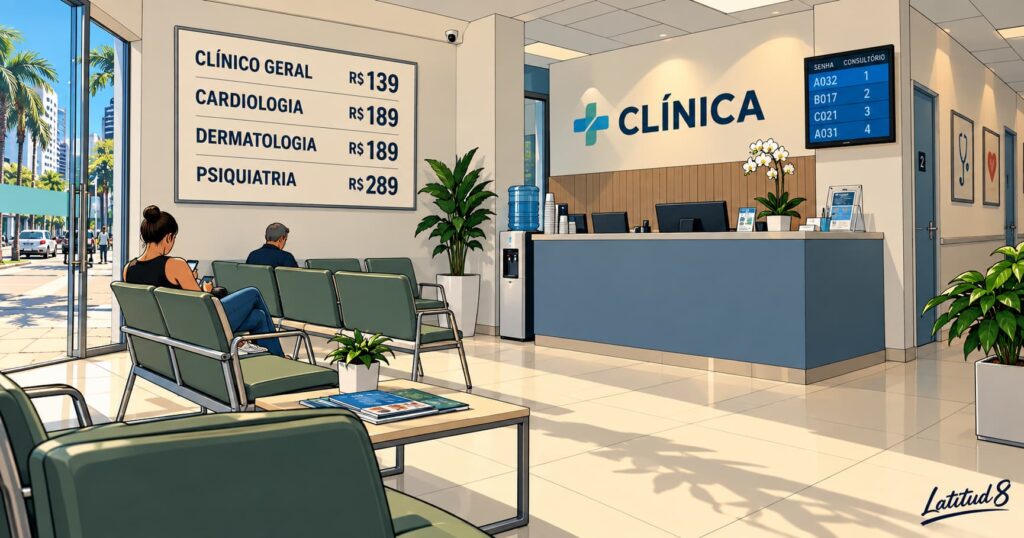
A standard private GP consultation in Fortaleza starts around R$139 (roughly €23 / US$27) at Clínica SiM, a transparent-pricing clinic chain with several Fortaleza locations. Specialists at the same chain run higher and are genuinely Fortaleza-priced, not a national estimate: gynaecology, dermatology, cardiology, or ENT run around R$189 (roughly €32 / US$37), and neurology or psychiatry around R$289 (roughly €49 / US$56) (clinicasim.com). That’s below the broader Brazilian 2026 range of R$150–800 for a specialist consultation depending on the field and city (atendja.com.br, 2026). That’s worth knowing, because it means Fortaleza is genuinely cheaper than the national spread implies for routine specialist care, not just for a GP visit.
An emergency room visit is the hardest cost to pin down. No Fortaleza hospital publishes an uninsured ER price list, and I couldn’t find one. For a sense of scale, hospitals in Espírito Santo state have charged anywhere from R$220 to R$2,000 (roughly €37–337 / US$43–388) for an uninsured ER consultation, depending on the hospital and demand (tribunaonline.com.br). That’s a different state, so treat it as the range, not a Fortaleza quote. Ask any hospital what an uninsured visit costs before you need one. This is why an ER visit without insurance is the scenario that turns into real money quickly, not the consultation fee itself.

A single 3-day hospital admission can cost as much as 180 GP visits. That gap is what a monthly premium is protecting against.
If you’re admitted, the daily room rate alone runs R$800–2,000 for a shared ward or R$1,500–5,000 for a private room (roughly €135–843 / US$155–971 per day). These are Southeast-capital reference figures, not a Fortaleza-specific rate, because no Brazilian private hospital publishes a public sem-convênio inpatient rate card. An ICU stay runs R$3,000–10,000/day nationally (roughly €506–1,687 / US$583–1,942).
And the room rate is only part of the bill. Physician fees, surgical centre use, anaesthesia, medication, and materials typically make up 60–80% of the final total. A realistic 3-day admission for a routine issue averages R$12,000–25,000 total nationally (roughly €2,023–4,215 / US$2,330–4,854) (saudecidade.com, 2026).
The GP and specialist consultation figures earlier in this section are genuinely Fortaleza-sourced from Clínica SiM’s published price list.

One cost everything above skips: an ongoing prescription. If you’re managing something like high blood pressure or thyroid medication long-term, that’s a recurring cost separate from any single doctor visit or hospital stay, and most of the plan comparisons in this article don’t fully address it.
Generic medication in Brazil is genuinely cheap by international standards. A common generic blood pressure medication (atenolol, 25mg) has run R$4–16 for a 30-tablet box in Northeast Brazil price surveys, with hydrochlorothiazide even lower (Procon Campina Grande, Paraíba rather than Ceará specifically, but the same Northeast pharmacy market).
Worth knowing too: Brazil’s federal Farmácia Popular programme subsidises or fully covers a set list of common chronic-condition medications, including for hypertension and diabetes, at participating private pharmacies, no private insurance required, though it typically needs a CPF and a valid Brazilian prescription to access.
Figures above use approximately €1 = R$5.93 and US$1 = R$5.15, current at the time of writing. Rates move — check today’s before comparing.
How to Actually Apply, If You’ve Landed on Genki Native

- 1 Enter your personal details on Genki’s sign-up page to see your price.
- 2 Add any family members if you’re insuring more than yourself — each person is priced and contracted individually, not as a household discount.
- 3 Choose Basic or Premium.
- 4 Pick your deductible: R$5,930 (€1,000), R$2,965 (€500), or none.
- 5 Choose a start date — anywhere from today up to 90 days ahead, which matters if you’re timing this around a visa application or a flight.
- 6 Complete the medical questionnaire. Genki gives you an instant decision, not a multi-week wait.
- 7 Make your first payment once accepted. From month two, payments are taken automatically each month.
- 8 Your insurance certificate arrives right after payment — the document you’ll need for a consulate application or your own records.
- 9 Cancel any month in Genki’s Member Center. The minimum is one month, and the end date is the day before your monthly anniversary.
Of the long-term-basing options, Genki Native is the one that comes up strongest across everything above. It’s nomad-specific, needs no fixed home country, and has a published application process that’s genuinely fast.
The one thing worth flagging before you start: you need to be 55 or under on your start date to qualify for Genki Native at all. If that’s not you, Genki Traveler goes up to age 69 (with a 1-year cap per contract), and Cigna Global or Allianz Care (mentioned earlier) are the other fallbacks.
How an Insurance Claim Actually Works
This is the part almost nobody explains, and it’s the part that matters most when you’re actually sick.
For an international plan like SafetyWing or Genki, it typically goes like this:
1. Pay upfront at the clinic or hospital. Most Brazilian providers expect payment at the point of care, not a promise of later insurer payment.
2. Get an itemised medical report and formal receipt (nota fiscal), not just a card payment slip. Providers will usually give you this if you ask, but ask explicitly and in advance if you can.
3. Submit the claim through the provider’s app or online portal, attaching the report, receipts, and any relevant diagnosis documentation.
4. Respond quickly to follow-up requests. This is where claims stall. Insurers often come back asking for additional documentation, and slow responses are the single biggest cause of delayed reimbursement.
5. Wait for reimbursement. This can take anywhere from a few days to several weeks depending on the provider and how complete your documentation was from the start.

For a local Brazilian plan with direct billing, it’s simpler in one specific way: the hospital bills the insurer directly, so you’re not floating the cost yourself while you wait to be reimbursed. That’s the single biggest practical advantage local plans have over international ones.
One thing worth doing before any of this happens: if theft or an accident is involved, get a police report (Boletim de Ocorrência) first. Most insurers, SafetyWing and World Nomads included, won’t process a claim without one. The full walkthrough is in our Fortaleza emergency numbers guide.
Guides that make this sound like a five-minute app submission aren’t being straight with you. Budget real time for documentation chasing, especially with international providers. That’s the biggest gap between “covered on paper” and actually reimbursed.
Steffany’s own experience is the clearest illustration of the difference. She’s never had private insurance in Brazil. She’s used SUS her whole life, and it’s genuinely two different systems depending on what’s wrong with you.
When she broke her arm as a kid, she was seen the same day, no wait at all. Other times it’s been slower. At a UPA (a smaller public clinic), she’s gone through triage, coded red, yellow, or green depending on urgency, landed somewhere between yellow and green, saw a doctor, and picked up her medication free at the clinic’s own pharmacy. All she needed was her Brazilian ID. Another time, at a different UPA, the wait got so long she left before anyone saw her.

That’s the honest version of SUS: fast when it’s genuinely urgent, unpredictable everywhere else.
And there’s no claim to file. No forms to submit later, nothing to wait on. Clinic staff take your details on arrival and that’s it.
What’s covered for free depends on the condition, too. Steffany’s mother has diabetes and uses SUS for her care, but some of her medication is free while other prescriptions she has to buy herself. And it’s not only for residents: SUS treats anyone actually in Brazil, tourists included.

FAQ
Is healthcare free in Brazil for foreigners?
Emergency care through SUS, Brazil’s public health system, is available to anyone regardless of nationality or residency status — it’s constitutionally universal. Non-emergency care is technically accessible too, but wait times and quality vary enough that most nomads and expats use private insurance for anything beyond a true emergency.
How much does private health insurance cost in Brazil?
It depends heavily on which category you’re in. Short-stay travel insurance runs roughly US$60–255/month depending on the plan and your age. Nomad health insurance like Genki Native starts around €190/month in your 20s and rises with age. It now has a one-month minimum, so you’re not locked in for a year.” Local Brazilian plans in Fortaleza specifically run roughly R$108–1,288/month depending on age and insurer, and are typically the cheapest option overall — but require a CPF and residency to buy.
Can foreigners get health insurance in Brazil?
Yes, in two different ways. International travel or nomad insurance (SafetyWing, Genki, and similar) can be bought from anywhere before you arrive. Local Brazilian plans (Hapvida, Unimed, Amil, Bradesco Saúde) require a CPF number and usually residency paperwork, so they’re only an option once you’re settled.
How good is Brazil’s healthcare system, and how easy is access?
Private healthcare in Brazil is generally well-regarded, and Fortaleza specifically has at least one hospital — Hospital Unimed Fortaleza — ranked among the world’s best in a 2025 international ranking. Access to private care is straightforward if you can pay or have insurance; access to free public care through SUS is universal in theory but can mean long waits for anything non-urgent.
What are the key differences between healthcare in Brazil and the US?
Brazil has a free, universal public system (SUS) that the US has no real equivalent to, alongside a private system that’s generally far cheaper than US private care for comparable quality. The trade-off is that Brazil’s public system carries longer waits, while US care — public or private — rarely comes free at the point of use.
What happens if I get sick before my insurance policy actually starts?
You’re not covered — this is the gap people miss when they time an insurance start date too close to a flight. Every provider in this article, international or local, only covers conditions and treatment from the policy’s start date onward; nothing retroactive. If you’re arranging insurance around a visa application or a move date, build in a buffer rather than starting cover the same week you land, so a delayed flight or a last-minute health issue doesn’t leave you uncovered during the gap.
Can I switch health insurance providers once I’m already living in Brazil?
Yes, for international plans — SafetyWing and Genki both let you sign up while already in Brazil, since neither requires home-country residency to apply. Genki Native has no fixed end date and a one-month minimum, so you can join while already in Brazil, stay covered continuously, and cancel any month if you later move to a local plan. The catch is continuity: switching providers (or even renewing a fixed-term contract like Genki Traveler into a new one) resets any pre-existing-condition waiting period you’d built up, so anything diagnosed while covered by Provider A — or under an earlier contract with the same provider — could be treated as pre-existing and excluded afterward. Local Brazilian plans work differently — under ANS’s portabilidade rules (RN 438/2018), you can carry your already-served waiting periods over to a new operator without restarting them, but only after a minimum two years on your current plan (three years if you served a pre-existing-condition waiting period), and only into a plan the ANS system rates as equivalent or better. That protection doesn’t extend to switching between an international plan and a local one, or vice versa.
Does Genki Native have a minimum contract?
Not any more. Genki Native used to require a 12-month minimum. It’s now one month, and after that you can cancel any month. There’s no fixed end date, so you can stay covered for as long as you need to.
